Quinceañera Hairstyles That Survive the Photo Session: Studio, Outdoors and the Crown
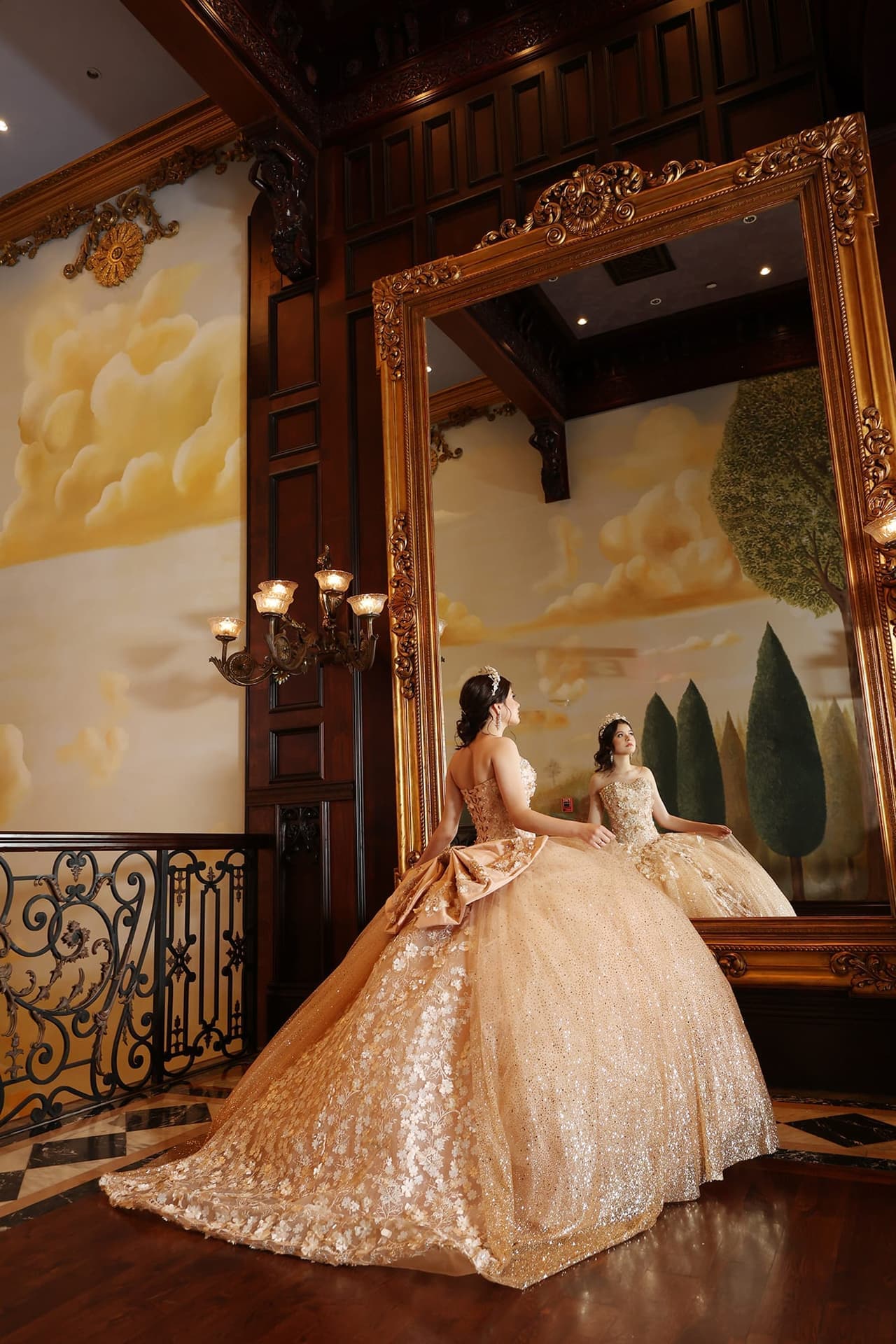
Quick Summary (TL;DR)
Choose the hairstyle by what it has to survive, not by the photo on your phone: two to five gown changes, air conditioning and then Florida humidity. The usual answer is not to choose at all — start with an updo for the most elaborate gown, finish with hair down for the outdoor half, because letting hair down takes minutes and pinning it up mid-session does not. Try the crown on with the hair already done, never before. Hair and makeup are included in all four packages and happen here, in the same room as the camera, which is why they can be decided together with the light and the gown.
Almost every family arrives with the hairstyle already decided from a Pinterest photo. It is a good starting point and it almost never survives the session intact, for a reason that has nothing to do with taste: that photo was taken once, with one light, with one dress, and with nobody pulling a gown over her head three times. Here the hairstyle has a different job.
What the hairstyle actually has to survive
This is not a party night. It is a photo session, and that means three things in a row:
- The wardrobe changes. Depending on the package there are between two and five. Every change is a gown going on and off over her head, and a loose updo does not survive the second one. It is the number one reason a beautiful hairstyle falls apart halfway through, and nobody warns the family beforehand.
- Studio air conditioning and Miami heat, on the same day. If the package includes a location, she walks out of a cool, dry studio into Florida humidity. Straight hair waves, curls open up, and the volume that looked perfect in the mirror behaves differently the moment the door opens.
- The hours. Whatever looks good in the first frame has to look good in the last one. A fringe that needs fixing every ten minutes eats session time, and that time comes out of the photographs.
So the useful question is not "which hairstyle is prettiest?" but "which hairstyle is still itself two hours and three gowns later?".
Session hair is not party hair
They are two different days and two different jobs, and mixing them up is one of the more expensive mistakes to undo.
Party hair has to last a night, dance the waltz, survive hugs and phone photos, and it is seen from a distance and in motion. Session hair is looked at close up, still, enlarged and on paper: a printed enlargement shows every misplaced pin and every strand that will not sit. Hair that looks spectacular at the party can look overloaded in a portrait, and hair that is perfect in a portrait can fall short in a ballroom.
The practical consequence is simple: if she likes a style for the party, the session is the ideal place to try it first, with time, and with someone looking at it from exactly where the camera will be. Plenty of families discover there that they want to change something, and arrive at the party with the decision already made instead of making it.
Up or down: what each one does in the frame
The real difference is not style, it is what stays visible.
An updo clears the neck, the shoulders and the neckline of the gown. If the gown has a worked bodice, beading, or straps that are half the reason she chose it, an updo is what lets them be seen. In the studio there is a second benefit: pinned-up hair does not fight the light. On the cyclorama the light comes from one side, and a loose strand throws a shadow across her cheek that then has to be retouched frame by frame.
Hair down gives movement, and movement is what keeps a photo from looking posed. It is the better choice outdoors, for walking frames, and for anything with wind in its favour. The price is that it covers the gown, and that in humidity it changes texture while you shoot.
The answer we give most often is that you do not have to choose: start up, finish down. The updo goes with the most elaborate gown, the one you want to see in full, and that is usually the first. Hair down goes with the casual half and with the move outdoors. Going from one to the other takes minutes — letting hair down is easy, pinning it up mid-session is not — and the family ends up with two looks instead of one.
The crown: how it is anchored and how it is lit
The crown is where most sessions go sideways, and almost never because of the crown.
Try it on with the hair already done, not before. A tiara sits differently on a high updo than on loose hair, and the spot where it actually anchors is not always where she pictured it. If the hair is done first and the crown goes on after, the stylist can build a base meant to hold it. The other way round means improvising.
The crown reflects light, and that is the whole point. Under studio light the stones throw back highlights, which is what makes it read as a crown rather than a grey ornament. Outdoors at midday those same highlights become blown-out white dots. It is one of the reasons outdoor frames are shot late in the afternoon, when the light arrives low and from the side: the crown sparkles without burning. We go into it in the golden hour piece.
There is no need to buy one. Crowns, tiaras and accessories come with the wardrobe — we explain it in quinceañera accessories. It is worth coming to the fitting, seeing which one works with the chosen gown, and deciding there, with the gown in front of you.
Hair and makeup go together, and they are included
All four packages — Simplicity, Elegance, Highlights and Timeless — include professional hair and makeup. There is no separate salon to book, no schedule to coordinate with another business, and no crossing Miami with the hair already done only to arrive with half the volume gone. It happens here, before we shoot, and the person doing it is in the same room as the person about to photograph it.
That last part matters more than it sounds. Hair built to look good head-on in a salon mirror is not the same as hair built knowing which side the light will come from and which gown is coming next. When both decisions are made together, they get corrected early: an updo goes up two centimetres because the neckline asks for it, a strand is left forward because the light falls on that side.
What changes between packages is not the hair, it is how many wardrobe changes there are and whether the session leaves the studio. They are all listed, with what each includes, in packages and services.
Five hairstyles that work in Miami, and where
- Low, polished updo with a defined part. The safest of all. It survives wardrobe changes without coming apart, leaves the neckline and shoulders completely clean, and pairs best with a heavily worked bodice. In the studio, on the cyclorama, it is close to foolproof.
- High updo with volume on top. The one that holds a crown best, because the base is built for it. It lengthens the neck and works beautifully in profile. It needs a gown that does not compete: if the bodice is already doing a lot, the hair has to give.
- Half-up with waves. The middle ground, and the most requested for that reason. It opens up the face without giving up the movement of loose hair. It is the one that travels from studio to location without being rebuilt: she can walk to the location in it.
- Loose waves. For outdoors, for walking frames and for the casual half of the session. In gardens like Fairchild or under the trees at Matheson Hammock, wind works in your favour. With high humidity, assume the wave will open up: shoot it at the end of the session, not the start.
- Braided updo or braid crown. The most durable of the five and the one least damaged by wardrobe changes. It works especially well when the gown is simple and the hair gets to be the detail, and in outdoor frames where the back of the head is visible.
None of the five is "the right one". The right one is whichever works with the gown she chose, and that decision is better made at the fitting, with the gown on, than on a phone the week before.
Curly, straightened, and what humidity does to each
In Miami this is not a detail, it is half the decision.
If her hair is curly and she is straightening it, the straightening holds perfectly in the studio and starts giving way the moment she steps into humidity. It does not get ruined: it opens up, gains volume and drifts back toward its own texture. If the package includes a location and the plan is to keep it straight, shoot the studio frames first and go outside afterwards, not the other way round. And say in advance that she is straightening, because it changes how much time to book before the first frame.
If her hair is curly and staying curly, the problem is the opposite and easier: curls behave better outside than in. In the studio, under air conditioning, they dry out; we work with product and touch up between changes. Outdoor frames are usually the best photographs of curly hair, so it is worth saving her favourite gowns for that half.
If her hair is naturally straight, the difficulty is making waves last. Waves get done as late as possible and set harder than seems necessary indoors, because what looks overdone under air conditioning looks normal twenty minutes later outside.
None of this forces a change of mind. It only changes the order things happen in, and that order is better decided the day you book than the morning of the session.
What is worth deciding in advance
Three things, and none of them is the exact hairstyle:
- Fringe or no fringe. It is the only thing that cannot be changed on the day. And if she is cutting one, leave two weeks: a fresh cut never looks the way she expects.
- Which hairstyle goes with which gown. If there are three changes, the most elaborate hair goes with the most important gown. It sounds obvious and it almost never arrives decided.
- One or two reference photos, not ten. They help enormously to understand what she likes. Ten different photos, on the other hand, turn into a conversation instead of a hairstyle.
Makeup follows the same logic and has its own rules about light: they are in quinceañera makeup.
Want to try on these dresses in person?
Book a private 1-hour fitting at our Miami studio with 300+ boutique gowns.
Frequently Asked Questions
How long before the session does the hair get done?
It happens here, the same day, before the first frame. Hair and makeup are included in all four packages, so there is no salon to book separately and no travelling across Miami with the hairstyle already done. If she is straightening curly hair, say so when booking: it changes how much time to leave beforehand.
Can the hairstyle change between gowns?
Yes, and it is what we recommend. Going from up to down takes minutes, so the usual plan is the updo with the most elaborate gown first and hair down for the casual half and the outdoor frames. The other direction — pinning it back up mid-session — costs real time, so it is worth planning the order rather than improvising it.
What happens to the hairstyle if it rains or the humidity is high?
The studio half of the session is unaffected — it is indoors and climate controlled. For the outdoor half, humidity opens up waves and softens a straightening, so those frames get shot at the end and, when the forecast is bad, the order is simply reversed. It is one of the reasons a session with a location is planned as studio first, outside afterwards.
Should she cut her hair or get a fringe before the session?
If she wants to, leave two weeks. A cut done the same week never looks the way she expects and there is no time left to fix it. The fringe is the only decision that genuinely cannot be undone on the day, so it is the one worth settling in advance.